

In a sunny bedroom art studio at her home in Heber, Janet Johnson paints beside her sweet dog Rosie, who lies on a cozy bed under the window to keep Janet company. Surrounded by semi-completed paintings, Janet continues to breathe new life into canvases that began as female-figure drawings. She layers the backgrounds with bold colors and abstract interpretations of animals and greenery, gradually transforming each piece into something entirely new. Even mid-process, the works are striking, offering a glimpse of the finished beauty that unfolds with every added layer. Figures are a new skill for Janet, but her life has been filled with art and nature since she was a little girl.
Going out into nature was a family tradition in Janet’s early life in Idaho. She would canoe on Jenny Lake and visit Jackson Hole back before the streets were paved. Her father was a geologist working in remote locations across the country, where she learned to love the land.
She also loved art. “It was my sanctuary when I was a little kid. My grandmother had an amazing collection of illustrated books, including [Robert Louis Stevenson’s] Treasure Island illustrated by
N. C. Wyeth. I was fascinated by his artwork, and so as early as I can remember I would just draw.”
From the age of 14 until she graduated from college, she worked in a nature center in Connecticut where they would raise baby raccoons and foxes–and she would draw them. The naturalists at the preserve were a huge influence on her. She continued to build a life that would meld her art with her love for the outdoors and passion for protecting the environment.
With a degree in outdoor recreation, Janet landed a job with the US Forest Service managing the Ski and Snow Ranger program. She was part of the environmental and cultural education program in Big and Little Cottonwood canyons’ ski areas, where she also directed about 20 volunteers who led skiing groups from the four ski resorts on tours to learn about the outdoors and environment. The program still exists today, now in partnership with Cottonwood Canyons Foundation. In her free time, she painted.
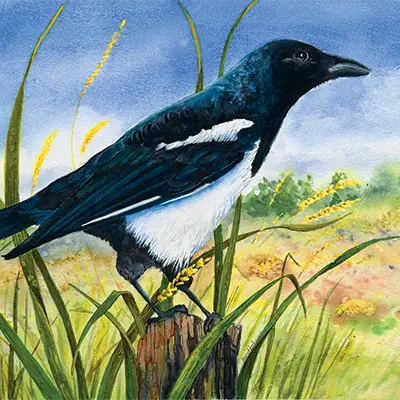

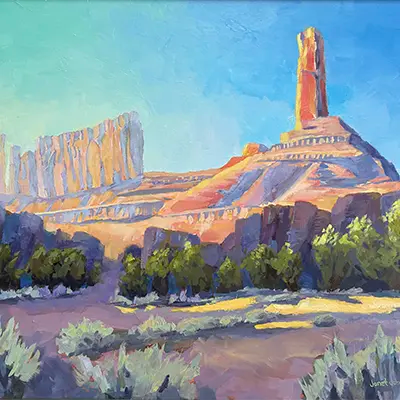


In the quiet hours of early morning or dusk, Janet would venture into nature, hiking until she found a scene that sparked inspiration. Carrying a small canvas and paints, she created her plein air works—a French term for painting outdoors, where artists capture the ever-changing light, atmosphere, and character of the landscape in real time. “You can’t mess around too long,” Janet says when searching for a spot, “because you want to catch the light at just the right time.” Her paintings were done in one sitting for about twenty minutes to an hour in each location, both for the light and because “you have oil paint and it’s messy, and you get it on you, and I’m picking flies out of it,” Janet says with a laugh.
But her goal was never perfection. “My goal was to really capture the natural colors out there rather than get a finished piece because you can’t, from a photograph, really get accurate color. The camera only has [about] 254 colors, so you lose so much. It’ll take the colors in a shadow and just make them flat, when there are so many beautiful colors in a shadow.”
During her time with the US Forest Service, Janet connected with amazing individuals who allowed her to create art for signs and resources at the National Parks, National Forests, and State and local natural recreation areas. Tourists who visit noteworthy sites like the Hoover Dam, Pawnee National Grassland, and multiple National Forests across the western United States will see Janet’s work on the informational signs that teach them about the area.
As years passed, though, her inspiration for landscape art waned. “I had some work in a local gallery, and a super cool older woman came in, and she goes, ‘These are just pretty paintings. This is not art.’ And I knew exactly what she meant. . . and said, ‘You know, you’re right.’”
She took a step to stretch her skills: figure drawing. “I’ve always wanted to do figures, but they’re intimidating. They’re very hard. If you can draw and paint the figure, you can paint and draw anything, because if something’s off on the figure, anybody can pick it out. You can just tell, and so I said, ‘It’s time.’”
Beginning with open studios like DRAW Inc. and Visual Arts Institute in Salt Lake City, she would show up and sketch multiple models in 20-minute chunks, building up her skills. She discovered a supportive community in these groups and, a year ago, she was invited to join a group of artists, hosted by well-known artist Booker Tueller, who gather once a week for two and a half hours and use the same model in the same pose for a month. These figures are a part of her newest collection of paintings in her studio.
Some are still just figures, but in others she has begun adding in backgrounds that hail back to her love for landscapes, animals, and the natural world. Shadowy foliage and creatures take shape behind her female figures.
“I’m trying to get the figure to morph in and out of the space and blend with the landscape. . . . What I’d like to do is get this concept of duality and non-duality and how we morph in and out of our memories and our space.” The creatures represent the parts of you that you feel you can’t talk about–imagination, experience, and spirituality. Though still works in progress, the paintings radiate a depth of emotion that is impossible to miss.
Several of these paintings will soon be on display in a December art show featuring the talented artists from Booker Tueller’s group.

