Tag: therapy

  • Nurturing Growth

    Nurturing Growth

    “The limits of my language mean the limits of my world.” Ludwig Wittgenstein

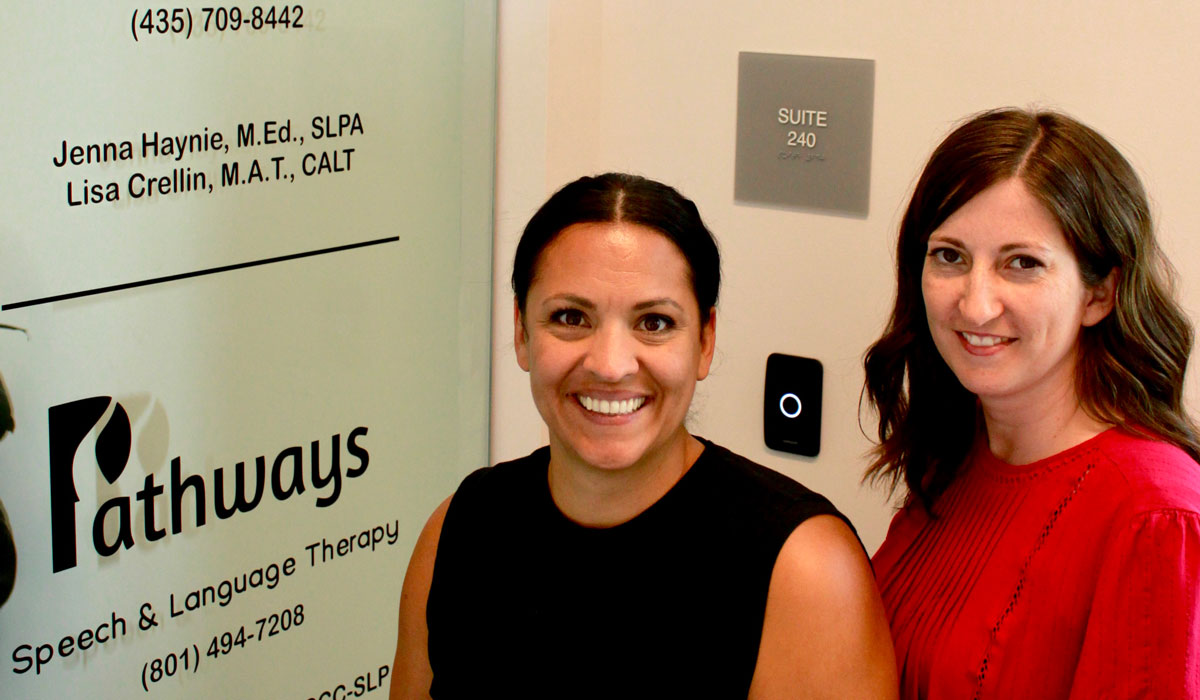
    Devany Browning and Jenna Haynie are helping individuals and families break through language limits in relation to speech and literacy. These two talented women recently joined forces; opening the doors to their joint office space. Jenna’s Literacy Utah and Devany’s Pathways Speech and Language Therapy go hand-in-hand, and, while they practice separately, they serve many of the same clients. Devany and Jenna are aware that the services they offer are not a one-size-fits-all program. They work hard to individualize what they do for each child.

    Pathways

    The mission of Pathways Speech and Language Therapy is: “To help children increase their ability to effectively communicate by providing powerful therapy that is uniquely adapted to each child and family, based on proven clinical techniques.”

    Devany works with children ages 2-18, but she emphasizes the importance of early intervention. Often parents think their kids will grow out of speech delays or impediments, but working on these struggles early on can be really beneficial. For Devany, it’s all about creating solid relationships and growing from there. “Really, it’s about first building that relationship with the child so they trust you enough to work on things that are hard for them,” she shares.

    Pathways Speech & Language Therapy -Devany Browing


    For many parents, it’s difficult to know when help is needed. Devany shares a few warning signs to look for at different ages and stages of development:

    • Not able to communicate their needs at age 2 and 3
    • Can’t say all the letter sounds clearly by kindergarten
    • Still struggling with reading by 1st grade
    • Issues with R sounds or S lisps by age 7
    • Unable to write clearly and put together complex sentences by 2nd grade

    While this list shares a few red flags, it is not comprehensive. If your child is struggling, reach out for a free 15-minute consultation. In that short amount of time, Devany can let you know if your child is on track, and if his/her speech and writing is age appropriate. Many people worry about financial constraints, but Devany is able to accept most insurance plans, and also works to help qualified candidates take advantage of a grant through United Health Care to relieve the financial burden. There are also many resources offered through the county and the school district. Devany works with and supports school SLPs and county intervention teams to make sure that children reach their goals.

    Devany’s unique background helps her serve her clientele with creativity and understanding. While working as a paraprofessional in a school setting, she saw the speech pathologists come into classrooms and work with kids one-on-one. Devany says, “I enjoyed working with kids with disabilities, but was overwhelmed by the classroom setting.” Devany decided to return to school and earn her master’s in Speech and Language Pathology.

    Vocabulary, reading comprehension, articulation, language delays, literacy, and spelling, all fall under the umbrella of speech and language. Devany shares, “The ability to process words and then hear individual sounds and manipulate them can be hard for kids. I focus on phonological awareness, which is the basis for being able to process sounds. Jenna’s team focuses on teaching explicit reading and spelling skills.” Together they do a combined dyslexia screening that looks at a myriad of factors that play a role in reading: reading fluency, writing fluency, vocabulary, and cognitive skills. They work with local psychologist, Ben Belnap, to do a full diagnosis. Aside from dyslexia, Devany also diagnoses articulation disorders and language disorders. Devany also has all the credentials and training to diagnose autism. This can be especially helpful to people on a long waiting list who want a diagnosis right away.

    Literacy Utah

    Jenna is highly trained in providing kids with the building blocks to not only be successful readers but to enjoy reading. According to her website, 1 in 5 students has dyslexia. That’s 20% of the population, and of that, only 1 in 20 are identified. Contrary to popular belief, dyslexia isn’t just having letters appear in a different order or backwards on the page. Dyslexia is an umbrella term for what Jenna defines as “an unexplained reason why they [children] can’t learn how to read.” It has nothing to do with vision or with intelligence. Jenna explains, “It has to do with how your eyes are seeing the information, but the most important step is what your brain is translating it into.” She notes, “For someone with dyslexia, it’s hard to retain all the information those little symbols (the alphabet) hold, and all the ways they can stretch.” As a certified dyslexia practitioner, Jenna can help students gain and retain that information. It just requires her teaching it in non-traditional ways.

    After Jenna earned her bachelor’s degree in Communicative Disorders and Deaf Education, she began work as a speech assistant at a middle school. During this time, she witnessed a lot of students struggling with reading who weren’t getting what they needed. Jenna wanted to offer more help to those students; so she went back to school and earned a Master’s of Education in Curriculum and Instruction.

    Literacy Utah -Jenna Haynie


    Jenna says, “I want everything we do to be impactful.” Literacy Utah’s goal is to build the neural pathways that children need to be fluent readers.

    Jenna compares building these pathways to the connection between a big screen TV and a DVD player. She explains, “You can have a massive big screen TV and a brand new DVD, but if the cord is broken, the communication between the two machines won’t work.” When the neural pathways are supported and strengthened, the brain can allow a reader to thrive. These neural pathways are strengthened as students are taught all the sounds a letter can make. They learn phonics in a different order than is traditionally taught in schools. Practitioners follow the student’s lead helping each child to master concepts at their own pace.

    There are several key indicators that may point to a struggle with dyslexia. Here are a few to look for:

    • Mixing up letters or syllables in words
    • Can’t come up with words that rhyme
    • Can’t remember sight words
    • Messy handwriting
    • Letter or number reversals beyond 1st grade
    • Limited vocabulary
    • Poor writing skills
    • Family member with dyslexia

    For the full comprehensive list and free online screener, head to Jenna’s website.

    One of the first places parents should go if they suspect their child is struggling is to their child’s teacher. Teachers can share standardized reading test scores that show if your child is at or below grade level. If your child has completed multiple grades, ask to see the test scores through the years so you can identify any trends. You can also ask for free testing through the school if you’re concerned. Interventions and accommodations are available.

    If kids aren’t on grade level with reading, now is the time to remedy that, regardless of age.

    Jenna has learned, through trial and error, how to create marked progress with reading struggles. She can even help kids who are pre-readers. Jenna puts together an individualized learning plan for a child using science and data. Jenna says with a smile, “Science and data are my friends.” She tests every six months and pivots based on what that child needs. Jenna moves at the pace of the student recognizing, “If they’re not learning, I need to change what I’m doing. This kid can learn. I need to approach it from a different angle.” She constantly asks herself, “What do I need to do to nurture your growth?” Jenna explains that some kids need 10 repetitions to understand something, while others need 2,000 repetitions. Data is constantly driving the direction of the work Jenna does with individual students.

    For the students, it’s not just about getting help. They develop a special relationship. Jenna describes the bond between her and her students, “You know when you’re just with someone and they […] have faith in you? And you just feel that and you know they’re your person on your team?” She says that bond has been an unexpected part of receiving therapy for some students. The faith she has in her students has promoted some incredible growth. Jenna has also helped college students who started their studies and recognized they needed some help in order to thrive. Another client approached her in his later years, just hoping to read his own email and to have the possibility of changing jobs. Jenna shares that for her students, “The world kind of opens in a way.”

    The help that Jenna and Devany offer is a team effort. They want parents and families involved. They want school professionals involved. Jenna says, “The more people on these kids’ teams, the better.” Services are also offered in office, and online. If you want to replace frustration with confidence and hope, if your child is needing some extra support in relation to reading, writing, and communicating, this clinic is a place to fill in the gaps and to find success.

  • Good Vibrations

    Good Vibrations

    “If you want to know the secrets of the universe, think in terms of energy, frequency, and vibration.”  – Nikola Tesla

    The positive or negative tone of a voice, the major or minor key signature of a song, or the volume and intensity of any sound, vibrates with tremendous power and energy. Simply put, sound is vibrational energy transmitted as waves that are perceived by the brain, heard by the ear, and felt throughout the body. Every cell in the body and every emotion are also made up of energy. It has also been proven that crystals give off natural vibrations. When “played”, a crystal singing bowl resonates with a vibrational frequency that matches a note in the C major scale, you know do-re-mi-fa-so-la-ti-do or CDEFGAB. A full set would have seven bowls so the whole scale could be used. These seven notes also correspond to the major energy centers, or chakras, in the body. Smaller bowls have higher pitches while bigger bowls have deeper pitches.

    A typical set of crystal singing bowls is usually white, as they are created from pure quartz. Personalized sets can be tailored with bowls made from various crystals that have their own natural colors. Tibetan bowls have similar properties as crystal bowls except they are made out of metal which produces richer and deeper sounds. Alchemy bowls have the ability to hold vibrations for longer periods of time, have more intense reverberations and longer-lasting tones with various harmonics and overtones. Singing bowls’ humming vibrations help balance body energy; allowing cantankerous, negative, and unhealthy vibrations in our emotional, spiritual, and physical bodies to be replaced with good, positive, and healthy vibes.

    Sound Healing

    Sound healing or sound therapy uses different vibrations to heal the body, mind, and spirit. Different instruments such as Tibetan bowls, crystal bowls, glasses, gongs, and tuning forks have the same effect to trigger relaxation, reduce blood pressure, calm stress, and harmonize energy fields. Sound therapy operates on two principles:
    First, that emotions vibrate at different levels, and second, that trapped, blocked, or unexpressed emotions can cause disease due to stagnating in the body. Unpleasant and uncomfortable emotions have lower vibrational levels than positive ones that are easy to express and metabolize. The word emotion is derived from the Latin word, emovere, which means to move out or through. Emotions are literally energy in motion.

    In quantum physics, everything is energy and has its own vibrational frequency. It is believed in many cultures throughout the world that our bodies have energy centers, called chakras. The most universal system is made up of 7 chakras, each associated with different organs, functions, emotional, mental, and spiritual issues. Each chakra is associated with a note. Going from bottom to top, root chakra coordinates to C, sacral chakra-D, solar plexus chakra-E, heart chakra-F, throat chakra-G, third eye chakra-A, and crown chakra-B.

    Since our bodies our mostly water, we are great conductors for vibrations. When the crystal bowls are played or struck, the vibrations penetrate internally releasing or balancing at least one of the energy chakras. When all 7 notes are played in various sequences or harmonies, all 7 chakras can be balanced. This is called a sound bath. When bowls are used, a mallet or wand is used to rub along the outside of each bowl, creating the various vibrational frequencies.

    Sound healing works in four ways: sympathetic resonance, brainwave entrainment, frequency following response, and balancing the brain’s left and right hemispheres. Sympathetic resonance is when the vibrations in one object produce vibrations in another. This is the principle that causes the body to vibrate at the same frequency as the sounds produced by crystal bowls, gongs, tuning forks and other sound healing instruments. Brainwave entrainment refers to the capacity of the brain to naturally synchronize its brainwave frequencies with the rhythm of external stimuli. The positive frequencies allow your cells to operate in harmony with each other, healing organs, bones and uncomfortable emotional states. Frequency following response deals with the mental states of consciousness and the different types of brainwaves: delta, theta, alpha and beta waves. Balance of the brain’s left and right hemispheres is when sound healing works on both sides of the brain to develop areas where we might be weak and improve communication between the hemispheres.

    Sound healing or sound therapy uses different vibrations to heal the body, mind, and spirit.

    Heber Valley’s Crystal Bowl Healer

    After moving to Utah twenty years ago, Theresa discovered crystal singing bowls while looking to overcome her own trauma and health issues, including severe mercury poisoning. Theresa shared, “Over twenty years ago, I realized that the quality of one’s life is directly related to their emotional health. Emotional health is the foundation beneath self confidence, and self confidence is the springboard to achievement […] This lead me to study various intuitive practices of healing work which focus primarily on emotional release. This work, along with several other lifestyle changes, has changed my life. As I was once sick, I am now healthy.”

    Today, Theresa has her own crystal singing bowl studio in Midway where she shares the peace and power she discovered on her journey to healing. Besides crystal bowl sound therapy, chakra alignments, and group sound baths, Theresa also offers drum circles, theta healing, and possesses a rare angelite table. If your “vibe” is off, check out her website, www.4youraura.com.

    Sound healing with crystal singing bowls compliments traditional western medicine and holistic eastern healing. We are all connected with the emotions we feel, the energy we experience, and the vibrations we sense.

    “The body is held together by sound. The presence of disease indicates that some of the sounds have gone out of tune”
    – Deepak Chopra

  • Take It Outside

    Take It Outside

    In 2010, Allison Page had an epiphany. When stressed or overwhelmed, a day on the trails with her girlfriends or a walk outside on her own was what helped her most. Realizing her best thinking and problem solving was done when she was outside walking, she began formulating a business plan, and TrailTalk® was born. The idea and now one of the company’s leading taglines is this: “taking therapy off the couch and onto the trail.”

    On the other side of the country, in Baltimore, therapist Megan Perry was sitting in a dark office with no windows, wondering what other options were out there. She began searching and discovered an innovative idea out of Park City: the opportunity to own a TrailTalk affiliate. After one trip, her first-ever visit to Utah, Megan was in. She and her husband moved across the country from Baltimore to call Heber home. When asked what drew her to TrailTalk, Megan stated, “This idea of walking and talking, not just being outdoors, but having that movement piece, could really elevate people’s experience with therapy and maybe make it even more productive than just sitting on the couch.”

    Megan had often wondered why we tend to compartmentalize physical health from mental health. Incorporating the outdoors and movement with mental health sessions just seemed to make sense. Combining the two has the power to enhance the whole therapy experience. Megan shares, “The theory and concept behind TrailTalk is to increase the integration of physical health with mental health . . . to give people more access to mental health therapy, and to take the stigma away from it.”

    How does taking therapy to the trail promote physical and mental health?

    Bilateral stimulation: Walking creates a rhythmic left-right motion that helps process traumatic memories or events and feelings. Walking can help us generate new ideas.

    Vitamin D: Getting out in the sunshine provides your body with the much-needed benefits of Vitamin D. In addition to numerous health benefits, Vitamin D is vital for regulating absorption of calcium and phosphorus; it promotes a healthy immune system, protects your teeth and bones, and improves the body’s resistance against certain diseases.

    Exercise: Activity and movement improve mood and burn calories.

    New Experience: Being in a different or fresh environment helps us stay curious and explorative.

    Practicing Mindfulness: Hearing birds chirping, leaves rustling in the breeze, and a stream gurgling down the hill provides an enjoyable scenario to practice being present and grounded.

    While hitting the trail is an excellent option for many, it’s not the right fit for every person or every kind of therapy. If an office visit is more conducive to a client’s needs, TrailTalk also has an office-on-wheels option. Their TrailTalk vans are equipped with a comfortable, quiet space to sit and converse.

    You may wonder if TrailTalk could be a good fit for you. Therapy is a wonderful option for people dealing with life crises: grief, life transitions, anxiety and depression, trauma, etc. However, therapy can also be largely preventative in nature. We see a doctor for our yearly health exam and a dentist for our biannual cleanings. We might visit with a financial planner to get our budget figured out and retirement in order, or a personal trainer to get our exercise regimen just right. Why not make a tune-up visit with a therapist to consider the state of your relationships or your progress on personal goals? Therapy is great for those who need to repair and heal, but it can also be approached from a wellness model to help people “thrive rather than just survive.” It’s for people who are working to be more authentic. It’s for people who feel stuck and can’t quite pinpoint why. It’s for people who find the same problems continually resurfacing in their relationships. Really, it’s for people seeking personal wellness in all aspects of life. Megan shares, “If you just feel like you’re not making the progress that you want, that’s when it’s time to come in and have someone who’s trained to see those patterns take a look.”

    How can trained professionals help? A therapist can help you identify where you may be stuck. They can offer ideas and resources, steps you can take, and areas where you might want to try a different approach. They can help you to see something from a new perspective and give you the tools you need to problem-solve in your own life. Sometimes all it takes is a couple of sessions to empower clients to move forward with clarity in an area they find challenging.

    One area that many of us find challenging is gracefully getting through the long winter months. Winter can genuinely challenge our mental health. Megan has several ideas that promote prime mental wellness during the coldest season:

    Get sunlight and Vitamin D: Even though Utah gets cold, we still get a lot of days with sunshine. Make an effort to get outside and catch some rays, even if it means bundling up. Getting sun is our most important natural source of Vitamin D. You may want to talk to your doctor about supplementing with Vitamin D as it can be difficult to get enough during the winter months. Megan says, “People think they have to go out and do a 10-mile hike. You just need to walk around the block.” Any outdoor activity is fine; just get outside every day!

    Socially engage: If we start feeling a little depressed, it’s easy to isolate ourselves socially. We have to push against that. Megan’s advice: “Send that text. Do that game night. Go to that dinner. Sometimes when you get depressed, you don’t feel like it, but doing something is always better than doing nothing.” She adds that our efforts to socially engage are critical to preventing or decreasing the severity or intensity of depression.

    Exercise and sleep: Getting your heart rate up and blood pumping can boost your mood and improve your mental state. A good wind-down routine at night can help set you up for a good night’s sleep, especially if you suffer from anxiety. Megan uses a cell phone analogy: “If you leave all your apps open all day, your battery is dead. You have to close out all the different apps constantly, so your phone stays charged. And your brain is the same way. If you go through your whole day and do no processing, by the end of the day, you’re on complete overload; then, you’re going to just sit there and think about stuff.” If this describes you, this next tip can be incredibly helpful.

    Take mini mental breaks: Try to take little pauses throughout your day. When you feel an emotion, pause and recognize what caused that feeling. Confront it. It’s easy to live our days completely over stimulated and constantly multi-tasking. Sometimes it’s helpful to slow down and do something mindfully without distraction. Doing this allows us to quiet the mind. Megan shares an example of how to do this, “If you’re washing the dishes, just wash the dishes. What does it smell like? What does it look like? What does it feel like?” If mindfulness feels foreign, it may be helpful to be guided through it a few times. Headspace is a great app to help you get started.

    This year of uncertainty is almost over. It has given us an incredible opportunity to lean in rather than resist. Megan shares some pertinent advice as we contemplate the changes we want to make in the coming year, “Go ahead and take that step. If people are anxious about making a change, perhaps that’s a sign that they need to back up and make it smaller and . . . more manageable.” Her closing words of advice to carry you through the new year, “Take your values and vision and align it with action. Actions don’t have to be grand, and they don’t have to be huge. It’s just picking something. Something is better than nothing.”

Translate